Since the mid-1970s, operating through scientific research front organizations, the Tobacco Cartel has supplied “Kentucky Standard Reference Cigarettes” to researchers worldwide for use in smoking & health research.
Touted as the answer to a need for standardization in smoking and health research, these “Reference Cigarettes” are manufactured using tobacco straight from the commercial supply, blended and produced without any additives, flavorings or other conventional cigarette constituents to give uniform, consistent and comparable resulting “smoke” to be used in research. Just tobacco. This “just tobacco” composition is intended to give scientific and medical researchers worldwide confidence in their results. Unfortunately none of the thousands of researchers over the past 50 years have known or accounted for these pesticide contaminants that were skewing all of their results on the toxicity of ‘tobacco smoke’, and they have accepted the results obtained from reference cigarettes as true representations of “tobacco smoke”, and never looked back.
Just below is hard data proving that the smoke from commercial tobacco cigarettes is so much more than Tobacco. This isn’t about the additives, or flavors, or burn-rate chemicals, that have dominated the discussions around the bad things that manufacturers put it cigarettes, or even the combustion byproducts and toxic gasses given off by all burning materials. Kentucky Reference Cigarettes are presented as free of additives and other materials used in commercial cigarette manufacturing, so researchers don’t have to factor them in to their interpretations of the data
.
This is about the complete absence of reference to a class of cigarette smoking hazards that have not been mentioned once in 50 years of the US Surgeon General’s “Reports On Smoking & Health”, or anywhere else. This is about somehow overlooked, or perhaps carefully concealed toxic mixture of man-made neurotoxins, endocrine disruptors, mutagens, obesogens and the other insecticides and fungicides that you can see below.
In this 2018 research on 5 popular brands the lab found 27 pesticides, all of them with known exposure consequences, and several banned due to extreme exposure hazards. None have ever been tested for exposure through inhalation in cigarette smoke. These pesticides are largely not combusted in smoking – instead they vaporize and dry-distill ahead of the burning cigarette coal and enter the smoke stream largely intact and in highly bioactive states. These pesticide aerosols are inhaled by every smoker with every puff, throughout the day, every day, and pesticide hazard information is never obtained by EPA with exposure regimens resembling the cigarette smoking scenario.

Diligent searching of worldwide research literature shows no mention of the presence of pesticides in “Kentucky Reference Cigarettes”, with the exception of the one CORESTA paper cited below, which means that they very likely have never been accounted for in analyzing and interpreting smoking and health data. The negative effects of smoking are routinely and without thinking attributed to tobacco as if tobacco smoke is the equivalent of cigarette smoke, which you can see it is not. It’s likely that none of the “smoking & health” researchers have known or thought to look for and account for insecticide/fungicide residues in their “tobacco smoke” data, and it appears that anyone looking to get such research funded would likely find the doors firmly shut.
As you can see from the University of Kentucky Tobacco Research Center’s FOIA response below, they have somehow just never gotten around to looking for or even mentioning pesticides in their “reference standard” cigarettes. At least not in writing that they are willing to reveal. So -Oops! Somehow they must have missed those confounding variables that, when factored into all those “Tobacco smoking” research results, invalidate billions of dollars in research that has ignored or, worse, discounted their presence. Since the Tobacco Cartel’s scientific front organization CORESTA publishes data on pesticide residue levels in commercial tobacco leaf worldwide, and since “Reference Cigarettes” are produced with tobacco from ordinary commercial sources, it seems more than probable that the U of K Tobacco Research Center would have been aware of pesticide residue contaminants in their “Kentucky Reference Cigarettes” since the beginnings of the program.
Since I can find no exceptions, it appears to me that every smoking & health researcher, every scientific and medical non-profit and university, and every regulatory authority in the world has been misled and co-opted by the Tobacco Cartel through the Kentucky Reference Cigarette program. How is it possible that the subject of pesticide residues in cigarette smoke has received virtually zero published scientific, medical or regulatory attention, and has been actively discounted and rejected by multiple Federal agencies, for 50 years and billions of dollars of smoking and health research? Not to mention the human toll of deaths from inhaling tobacco smoke infused with pesticides, unknown to the doctors who have been trying to treat them.
These same doctors, by the way, buy into the “tobacco kills” meme 100%, not realizing that chronic pesticide exposure certainly does cause a wide range of disease, but nobody knows if smoking tobacco cigarettes without pesticides would have the same, or maybe different results, because the health effects of smoking without pesticide exposure has never been researched. I do mean never.
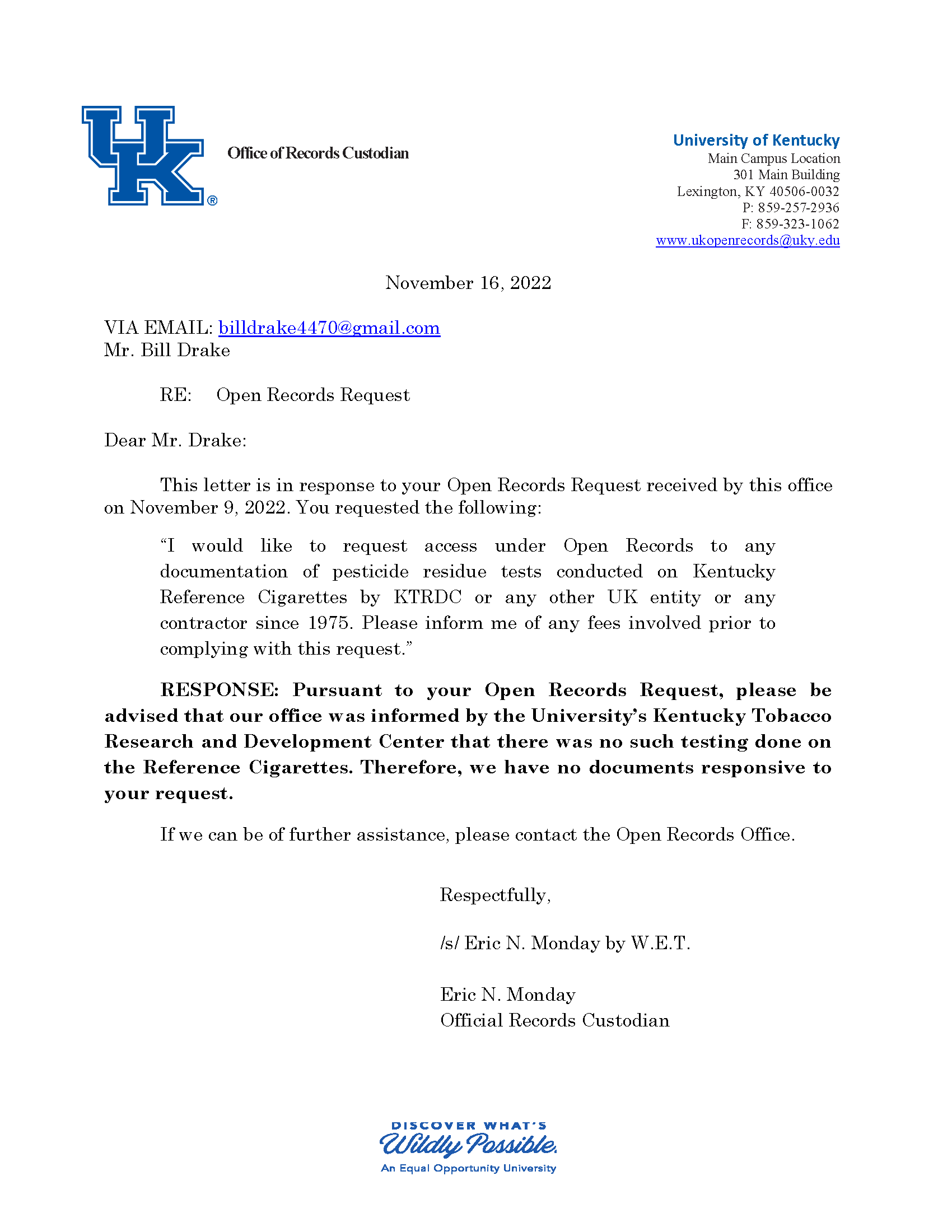
Don’t you love their slogan – “Discover what’s wildly possible!”. Yes, by all means, let’s discover what inhaled pesticides do to smokers completely independently of whatever tobacco may or may not do.
Oh – and about that “We didn’t do it” response , check out this rather detailed paper from 1976 in which it’s clear that DDT contamination of Kentucky Reference Cigarettes was known at the time. In fact, this paper discusses it in detail. When I pointed this out to the UK folks they said “Oh we didn’t have anything to do with that testing. It was done in the entomology department.”
Chlorinated Insecticide Residues in The University Of KentuckyReference And Alkaloid Series Cigarettes (1976) https://www.coresta.org/sites/default/files/abstracts/Tobacco_Science_1976_20-8_p._22-25_ISSN.0082-4523.pdf
“The transfer of DDT-TDE residues to mainstream smoke has been the subject of several investigations.
Generally, 12 to 18% of the p,p’-DDT and p,p’-TDE residues on cigarettes are transferred intact to the mainstream smoke (1, 5, 15, 16).
In addition, p,p’-TDEE has been found at levels amounting to 13 to 46% of the identified chlorinated hydrocarbon residues in smoke condensate.
From this study, as well as others, it may be assumed that 15% to 30% of the DDT-TDE residues present on the tobacco will be carried over to the mainstream smoke.”

Catch that? In 1969 everyone who smoked was inhaling DDT, endosulfan, dieldrin, and endrin, because Kentucky Reference Cigarette tobacco is pulled straight from the commercial supply. If you’ve never heard of Endrin I’m not surprised – it was one of the worst organochlorines ever made and didn’t last long. However in its short life span it was inhaled a hundred times a day by millions of people who were smoking in those years.
| Pesticide | First Registration Date |
|---|---|
| DDT | 1945 |
| Aldrin | 1948 |
| Dieldrin | 1950 |
| Heptachlor | 1952 |
| Chlordane | 1954 |
| Endrin | 1950 |
| Toxaphene | 1947 |
Let’s do some simple side-by-side testing of pesticide-free, USDA organic tobacco cigarettes with today’s so-called “reference standard cigarettes”. There won’t be any DDT, Endrin, Dieldrin or Endosulfan (at least not in the newest Reference cigs) but as you can see by the data in this post, there are dozens of pesticides taking their place.
Isn’t it just “wildly possible” that inhaled pesticides are responsible for some portion of ‘smoking-related disease’, and not tobacco itself? How would we know, when virtually every ‘smoking & health’ study for almost 50 years has used these ‘reference’ standards in the belief that their data was from ‘tobacco’?
Tobacco has never been tested, only Kentucky Reference Cigarettes, which are contaminated with an unreported, unrecognized set of pesticide chemicals that have their own completely independent pathological effects, independent of anything that the tobacco smoke itself may be causing. This is classic Apples and Oranges language and appears to deliberately obscure the reality of smoking hazards.
The CDC understands very well that there are differences between commercial tobacco and Native American sacred tobacco, which is grown without pesticides, so there’s no excuse for conflating all “tobacco” together in their propaganda.”When CDC references tobacco on this website, we are referring to commercial tobacco and not the sacred and traditional use of tobacco by some American Indian communities.”
All interpretations of smoking and health research based on Kentucky Reference Cigarettes are fatally flawed by these unrecognized highly bioactive confounding variables – and by the unquestioned assumption that Tobacco smoke and cigarette smoke are one and the same.
And FDA must be 100% aware of the presence of pesticides in Kentucky Reference Cigarettes – according to the Kentucky Tobacco Research & Development Center website:
“KTRDC has considerable resources and infrastructure dedicated to analyze tobacco and tobacco products. Much of this support comes from two Cooperative Agreements between KTRDC and the FDA totaling over $15 million. These funds have been utilized to establish the Center for Tobacco Reference Products (CTRP) within KTRDC. The CTRP provides reference tobacco products as standards for tobacco and tobacco product analyses. CTRP research focuses on constituent measurement and method development. The reference products are a necessary tool for measuring and reporting constituents as required by the Family Smoking Prevention and Tobacco Control Act and are sold to the tobacco research community throughout the world.”
The “constituents” referred to include any chemicals that are harmful or potentially harmful to smokers, and while testing for and revealing them is mandated by the Family Smoking Prevention and Tobacco Control Act of 2009, but there’s not a single pesticide on FDA’s HPHC list.
So smoking and health research throughout the world has been severely compromised for the past 50 years by a program funded by FDA.
However, FDA has apparently never once raised the issue of pesticide contamination of Kentucky Reference Cigarettes. In response to my FOIA request on the subject FDA replied:
” You also requested any documentation of communications in any form, physical or electronic, occurring between 1976 and present, between any office of FDA and the University of Kentucky’s “Kentucky Tobacco Research and Development Center” (KTRDC), or the University of Kentucky’s “Center for Tobacco Reference Products” (CTRP), that concerned or that referenced the subject of testing for insecticide, herbicide, or other pesticide residues in any of the past or present series of Tobacco Reference Products produced by KTRDC and/or CTRP.
Your request was received in CTP on October 30, 2023.
Your request has been processed under the FOIA, 5 U.S.C. § 552.
A comprehensive search was conducted in CTP’s Office of Science’s Submission Tracking Database for records responsive to your requests. Additionally, a comprehensive search was conducted in CTP’s Office of Compliance and Enforcement. Unfortunately, we were unable to locate or identify responsive records. CTP does not have any responsive documents for this request.”
Please check these results again from the tests for “Smoke No Evil” in 2018. Although not widely read, this book documents this unrecognized hazard in a new way.
Now check the results of 2022 research by the Saudi Health Ministry – the first such data on commercial cigarettes published by any government in over 50 years. Interesting to see that both Marlboros and Camels are in both samples. The “Smoke No Evil” brands were selected randomly by the testing lab, whereas the Saudi brands were selected by ranking among Saudi smokers.

If you have questions about my assertion that researchers have almost zero awareness of pesticides in Kentucky Reference cigarettes, check out a few representative articles like these and see if you find any reference to the presence of pesticides.
Evaluation of In Vitro Assays For Assessing the Toxicity of Cigarette Smoke and Smokeless Tobacco
For some additional perspective on the Tobacco Cartel con game and FDA complicity please see:
panaceachronicles.com/2021/03/01/the-fda-tobacco-cartel-confidence-game/
To emphasize the FDA’s complicity in maintaining this criminal fraud, check the warning they force on all advertising of the only pesticide-free tobacco cigarette alternative. What do you think the FDA’s game could possibly be here? Whatever it is, the game is clearly not about protecting the public.

Tobacco products without pesticide contamination are not safer than heavily contaminated tobacco products. Really?
That’s what the FDA and those who control the FDA, including the multinational pharmaceutical and chemical industries, want the American public to believe, and so far not too many people seem to be catching on.


 panaceachronicles