Check the data below and I think you’ll agree that it looks like young people smoking Swisher Sweets, or rolling blunts with them, are seriously risking early-onset Parkinson’s. As you can see from the cited research, the pesticides DDT and Carbendazim that contaminate every Swisher Sweet are known to “cause selective degeneration of dopaminergic neurons” and are being inhaled with every puff and toke.
“Eleven Crucial Pesticides Appear to Regulate Key Genes That Link MPTP Mechanism to Cause Parkinson’s Disease through the Selective Degeneration of Dopamine Neurons” (Brain Science, 2023) https://www.ncbi.nlm.nih.gov/pmc/articles/PMC10377611/
“Pesticide exposures are a major contributing factor to PD. Several studies report that chronic pesticide/chemical exposure may cause and/or accelerate neurodegeneration. For instance, Langston JW et al. (2017) report that MPTP affects the nigrostriatal dopamine system, accelerating neuronal death. Loss of dopaminergic neurons creates dopamine demand that diminishes neuronal connectivity and causes cardinal symptoms in PD.
“Notably, most pesticides are highly lipophilic, easily cross the BBB, and accumulate in different brain regions. Subsequently, pesticides may use multiple neuronal receptors for their internal cellular transport to disrupt neuronal function. Pesticides may use multiple membrane receptors expressed by the neuronal types, but the mechanism leading to the selective loss of dopamine neurons in the substantia nigra of the human brain is largely unknown.“
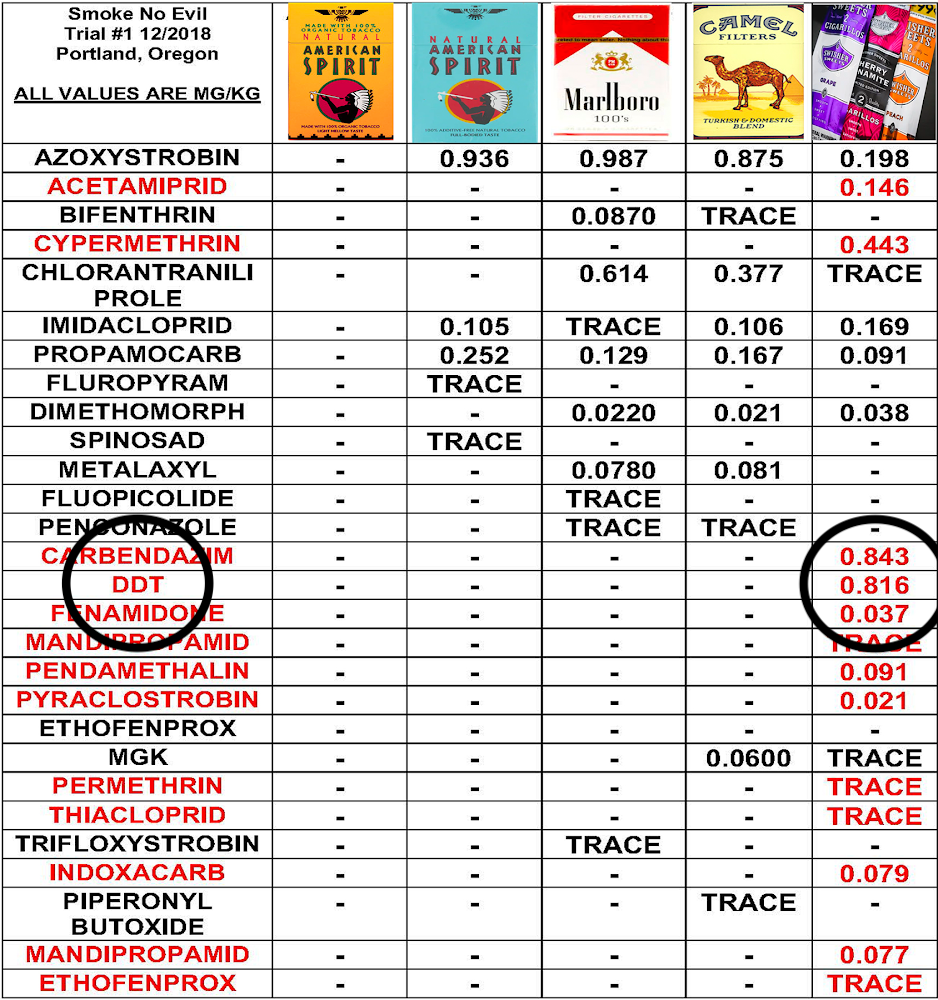
As a point of reference, the average level of residual DDT found in 169 US food sources in the 2018-2020 FDA Total Diet Study was 0.0002 Mg/Kg. Compare that with the 0.816 Mg/Kg you see above, and consider the magnitude of the increased risk. Every Swisher Sweets blunt will contain 4080 times the residual DDT in the food chain, and in spite of a worldwide ban, this heavy concentration must come from recent, direct DDT application to the tobacco in the field during production. Carbendazim and DDT are both banned worldwide, so what they are doing on tobacco products in the US is an open question. My guess is that the tobacco is from either India or China.
“Overall, this study demonstrates the behavior of 11 critical pesticides that cause selective degeneration of dopaminergic neurons and that behave similarly to MPTP to cause Parkinson’s disease.”
Here are the 11 critical pesticides that cause selective degeneration of dopaminergic neurons, with their Pubchem IDs and connection with smokers & tokers:
Benomyl (CID_28780)\
Carbendazim (CID_25429) (Currently contaminating Swisher Sweets)
S-methyl-N-butylthiocarbamate (CID_11137311) (Currently contaminating cigarettes)
Dichlorodiphenyltrichloroethane- DDT (CID_13089) (Currently contaminating Swisher Sweets)
Dichlorodiphenyldichloroethylene- DDD (CID_3035) (Contaminating cigarettes for decades)
Dieldrin (CID_969491) (Contaminating cigarettes for decades)
Heptachlor (CID_3589) Contaminating cigarettes for decades)
Heptachlor epoxide (CID_13930) (contaminated cigarettes in the 1960s-70s)
Lindane (CID_727) (contaminated cigarettes for decades)
Maneb (CID_3032581) (contaminated 1950s/60s cigarettes; currently contaminates many cigars)
Rotenone (CID_6758).
What Is MPTP, Whose Action These Pesticides Mimic?
https://www.sigmaaldrich.com/US/en/product/sigma/m0896
“1-Methyl-4-phenyl-1,2,3,6-tetrahydropyridine (MPTP) is a piperidine derivative and dopaminergic neurotoxin, useful in neurological research. MPTP is metabolized to 1-methyl-4-phenylpyridine (MPP+), which in turn can cause free radical production in vivo and lead to oxidative stress. Thus MPP+ is generally acknowledged as the active metabolite of MPTP. MPTP is widely used in in vivo research studies as a model for Parkinsonism. A review describes the application of MPTP in studies related to programmed cell death in neurogenerative diseases.”
There is a whole field of study involving Parkinson’s and pesticides, many of which are also known tobacco product contaminants; see also:
“A pesticide and iPSC dopaminergic neuron screen identifies and classifies Parkinson-relevant pesticides”
https://www.nature.com/articles/s41467-023-38215-z
The International Journal of Biochemistry & Cell Biology
https://pubmed.ncbi.nlm.nih.gov/15743669
“Dopaminergic neurons of the midbrain are the main source of dopamine (DA) in the mammalian central nervous system. Their loss is associated with one of the most prominent human neurological disorders, Parkinson’s disease (PD).. Although their numbers are few, these dopaminergic neurons play an important role in the control of multiple brain functions including voluntary movement and a broad array of behavioral processes such as mood, reward, addiction, and stress.”
Genetic and Epigenetic Alterations Induced by Pesticide Exposure: Integrated Analysis of Gene Expression, microRNA Expression, and DNA Methylation Datasets
https://pmc.ncbi.nlm.nih.gov/articles/PMC8394939/
“The results obtained demonstrated that 20 miRNAs were significantly altered by pesticide exposure, of which five were up-regulated and 15 were down-regulated. Among these miRNAs, hsa-miR-210-3p is of particular interest as it has already been associated with the development of Parkinson’s disease, associated with exposure to pesticides and other toxic substances.
“In particular, Zhang and colleagues (2017) demonstrated that the alteration of the expression levels of hsa-miR-210-3p contributes to the dopaminergic damage observed in meperidine (MPTP)-induced Parkinson’s disease.
“Other studies have shown that hsa-miR-210 is also involved in the detoxification of xenobiotic substances and in the regulation of the cellular redox state.
“Similarly, hsa-miR-126 and hsa-miR-29b have been previously associated with pesticides. Specifically, Yuan and colleagues demonstrated that the serum levels of these two miRNAs were significantly altered in a large series of individuals subject to acute organophosphorus poisoning compared to a group of individuals not exposed to these substances.
“Among the miRNAs identified here, hsa-miR-181c-5p has also already been associated with the development of Parkinson’s disease. Indeed, it was recently demonstrated that this miRNA is significantly dysregulated in both blood samples and in substantia nigra samples obtained from patients with Parkinson’s disease. In the study of Wirbisky and colleagues (2016), the authors highlighted how the miRNAs identified here are involved in the pathogenesis of neoplastic, neurodegenerative, and vascular diseases. All these studies showed a direct association between pesticide exposure, miRNA alteration, and the development of neurodegenerative diseases.”
And then …
Environmental neurotoxicant-induced dopaminergic neurodegeneration: a potential link to impaired neuroinflammatory mechanisms
https://www.ncbi.nlm.nih.gov/pmc/articles/PMC6520143
“Indeed, a definite causality has been identified between pesticide exposure and mitochondrial dysfunction.“
So, if the relationship between pesticides, Parkinson’s and tobacco products makes sense and looks probable or at least possible, you’ll probably also want to check out the possible Alzheimer’s connection. Same story – zero government regulation and massive exposure of young smokers and tokers.


 panaceachronicles
Hi Bill,
Thanks for keeping us informed about the hidden dangers of conventional tobacco. I personally encourage people to grow their own. It is relatively easy to grow and cure tobacco, although like anything its easy when you know how and somewhat daunting to get started. My new book “Growing Plant Medicine Vol 2” covers tobacco under the nightshade family chapter. You can check our organic tobacco seed at http://www.strictlymedicinalseeds.com
Meanwhile, thanks for keeping on educating and watch out for those swisher sweets. . . honestly they never were a good idea.
Your friend,
Richo
LikeLike
Hi Richo – thanks for your generous comment and I second your suggestion that people grow their own everything! Cheers Bill
LikeLike