If like millions of people you smoke or vape cannabis or tobacco, you’ve had to deal way too often with others who think you shouldn’t, and they usually point to your health as the reason.
I’m definitely not warning against smoking or vaping – I’ve been doing both for over 65 years. I’m saying there’s one simple fact everyone needs to know to protect ourselves from Diabetes onset or progression as we enjoy our cannabis or tobacco.
Protecting ourselves is pretty easy – we simply have to avoid pesticide-contaminated conventional cannabis and tobacco. Here’s how that works.
There’s a large and growing body of scientific research showing that exposure to a broad range of pesticides is strongly linked to the development and progression of both Type 1 and Type 2 diabetes. This isn’t fringe science – it’s well-documented and widely accepted in the medical community.
So this is a heads-up about a simple choice you can make to very significantly decrease your risk of development and slow the progression of Type 2 diabetes, and even to slow the onset and progression of Type 1.
The choice is to protect yourself by smoking or vaping pesticide-free tobacco or cannabis, or to continue to smoke or vape pesticide-contaminated cannabis or tobacco and suffer radically increased risk. While this is a clean and easy choice to make it’s also a life-altering decision with positive results that you will appreciate for the rest of your life.
Pesticides Hidden in Smoke or Vapor
Whether it’s tobacco or cannabis, all commercial growers use pesticides. That’s not news – pesticides are used to protect economically valuable crops by killing “pests” that destroy them, and tobacco is in the top three most valuable crops in dozens of countries, while the economic value of cannabis needs no explanation.
Problem is that pests are notoriously hard to kill, so pesticides are designed to attack them at their most vulnerable points – their nervous systems, their respiration and metabolism, their hormones, their organs, glands and reproductive systems. Unfortunately, human nervous, hormonal and reproductive systems are functionally and biologically pretty much the same as those of insects.
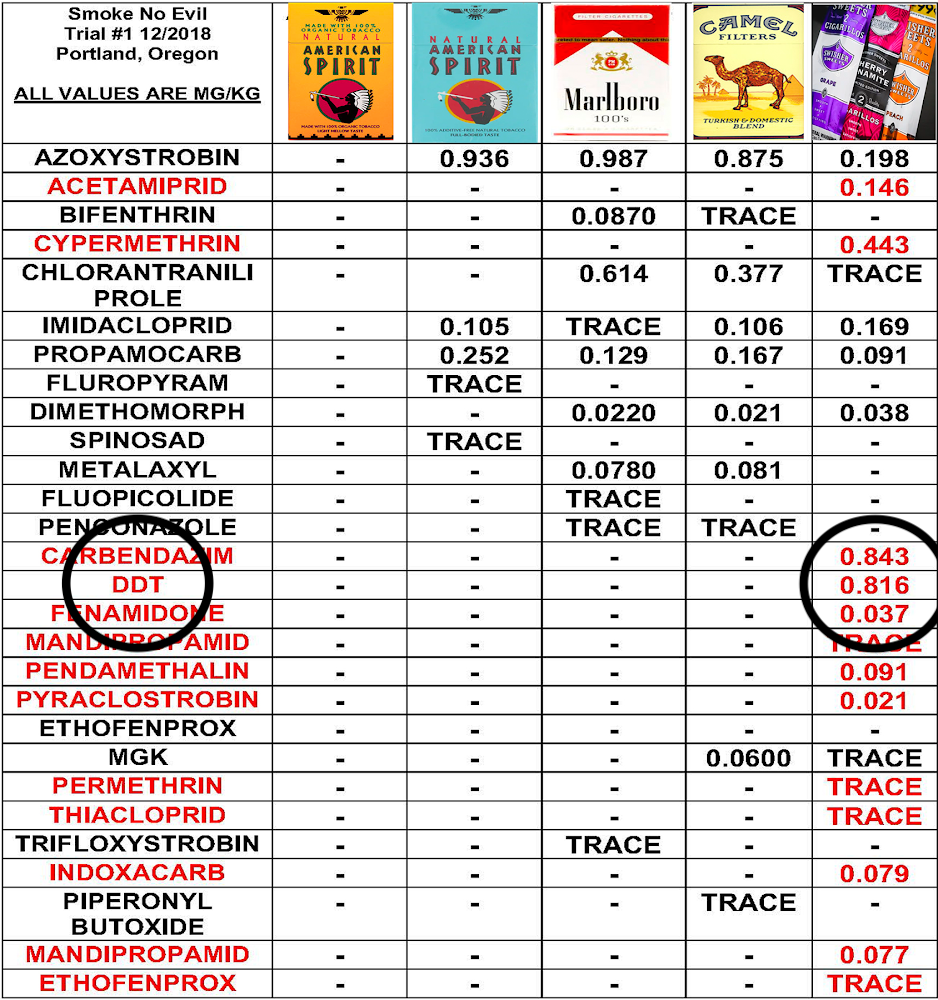
Please don’t fall for the old “it’s only a tiny dose” argument either – pesticide chemicals are designed to work at the molecular level, and don’t depend on dosage to have the desired effects. It’s critical to realize that through smoking or vaping you’re being exposed to these pesticides dozens or maybe hundreds of times a day – far more frequently than any other kind of pesticide exposure.
Even more unfortunately, there are exactly zero regulations on pesticides in cigarettes, and state-level cannabis pesticide regulations are a very bad, unscientific and medically fraudulant joke.
This all means that nobody officially cares about mitigating your risk, and so you’re on your own.
So please realize that every time you fire up a commercial tobacco or cannabis product, you’re not just inhaling nicotine or THC, which is all you want and what you pay for. You’re also inhaling a micro-cocktail of neurotoxic, endocrine-disrupting pesticides, which you never asked for and were never told about. And unlike pesticides in your food, which pass through your liver and are detoxified before they enter the rest of your body, pesticides you inhale go full-strength directly to your blood, brain, nerves and glands.
And right there’s the connection to diabetes.
The Science Is Clear: Pesticides and Type 2 Diabetes
Pesticides promote diabetes by increasing gluconeogenesis, the metabolic pathway that produces glucose from non-carbohydrate substrates, and also by inhibiting acetylcholinesterase, stimulating oxidative stress and inflammation, destroying critically important colonies of the gut microbiome, and disrupting circadian rhythms.
So even if you’re not worried about smoking or vaping tobacco or cannabis itself, the pesticides that contaminate these incredibly popular flowers and leaves are a serious threat to your health. If you’re already at risk for diabetes, inhaled pesticides are making things much worse for you whether it’s immediately obvious or not, and if you already have diabetes Type 1 or 2, there’s a simple way you can demo the truth of this for yourself.
You’ve Got Options
The good news is that despite all the propaganda we’ve been subjected to for years, no one has to quit smoking or vaping to make smarter healthier choices. There are pesticide-free options available nearly everywhere. Pesticide-free cigarettes like organic American Spirit are readily available, and certified pesticide-free medical cannabis is pretty easily available most places.
Even better, grow your own Cannabis where that’s legal and be sure it’s clean.
So, if you step back and think about it – why are all the health-related arguments in the tobacco/cannabis spaces on the side of cessation and none on the side of pesticide-free alternatives?
Why haven’t there been any published studies of pesticide contamination of tobacco products since the 1970s?
Why are there precisely zero studies on the health effects of the chronically inhaled pesticides in cannabis?
Could it be that nobody in the entire government/corporate/non-profit complex knows that dozens of pesticides are being inhaled every day by tens of millions of people, somehow missing the greatest exposure in the history of toxic industrial chemicals? How unlikely is that? We know they know, and we know they’re hiding it.
Well, instead of wondering why there’s this curious absence of any kind of warning about pesticides, organically-raised or lab-tested pesticide-free tobacco and cannabis products are increasingly available and choosing them will make a real difference – especially if you’re diabetic or pre-diabetic.
With the full picture, you can make informed choices. When it comes to your health, knowledge really is power – the power to make the best choices for yourself and those who love you and want you to stay healthy and happy.
With that in mind, here’s a quick look at that picture:
For individuals with diabetes or pre-diabetes, exposure by inhalation to the pesticides known to contaminate Tobacco and Cannabis may:
- Exacerbate insulin resistance
- Impair glucose metabolism
- Increase oxidative stress
- Disrupt mitochondrial energy production
- Inflame adipose and hepatic tissues
These exposures will not only worsen glycemic control but also heighten vulnerability to chemical dependency via shared neurochemical pathways.
Verified Cannabis & Tobacco Insecticide Contaminants
| Pesticide | Class | Mode of Action | Diabetes-Relevant Impact |
| Acetamiprid | Neonicotinoid | nAChR agonist | May alter insulin signaling via cholinergic pathways |
| Bifenthrin | Pyrethroid | Sodium channel disruption | Linked to inflammation and insulin resistance |
| Cypermethrin | Pyrethroid | Sodium channel prolongation | Associated with impaired fasting glucose |
| DDT, p,p- | Organochlorine | Sodium channel neurotoxicity | Strongly linked to Type 2 diabetes in multiple studies |
| Ethofenprox | Pyrethroid ether | Sodium channel targeting | Similar risks as other pyrethroids |
| Imidacloprid | Neonicotinoid | nAChR overstimulation | May affect glucose homeostasis and insulin levels |
| Indoxacarb | Sodium channel blocker | Nerve signal inhibition | Potential for metabolic disruption via neurotoxicity |
| Permethrin | Pyrethroid | Sodium channel kinetics | Associated with increased diabetes risk |
| Tetramethrin | Pyrethroid | Extended nerve excitation | May contribute to insulin resistance via neuroinflammation |
| Thiacloprid | Neonicotinoid | nAChR binding | Possible disruption of insulin-glucose balance |
| Spinosad | Macrocyclic lactone | nAChR and GABA modulation | Potential endocrine and metabolic effects |
Verified Tobacco/Cannabis Fungicides: Mitochondrial and Endocrine Disruptors
| Pesticide | Class | Mode of Action | Diabetes-Relevant Impact |
| Azoxystrobin | QoI | Mitochondrial Complex III inhibition | Impairs energy metabolism, may worsen insulin resistance |
| Carbendazim | Benzimidazole | Mitosis inhibition | Linked to endocrine disruption and metabolic stress |
| Cyprodinil | Anilinopyrimidine | Methionine biosynthesis inhibition | May affect hepatic metabolism and insulin signaling |
| Dimethomorph | Morpholine | Sterol synthesis blockade | Potential lipid metabolism disruption |
| Fenamidone | QoI | Electron transport inhibition | Mitochondrial dysfunction risk |
| Fludioxonil | Phenylpyrrole | Osmotic signal disruption | May affect adipocyte function and glucose uptake |
| Fluopicolide | Benzamide | Membrane protein targeting | Unknown metabolic effects, but potential for cellular stress |
| Fluopyram | SDHI | Succinate dehydrogenase inhibition | Directly impairs mitochondrial respiration—critical for glucose metabolism |
| Flutriafol | Triazole | Ergosterol biosynthesis inhibition | Triazoles linked to endocrine disruption |
| Mandipropamid | Amide | Cellulose synthase inhibition | May affect gut microbiota and nutrient absorption |
| Metalaxyl | Phenylamide | RNA polymerase I inhibition | Potential hepatic and pancreatic effects |
| Penconazole | Triazole | Ergosterol biosynthesis inhibition | Endocrine and metabolic disruption risk |
| Propamocarb | Carbamate | Lipid synthesis inhibition | May impair adipocyte function and insulin sensitivity |
| Pyraclostrobin | QoI | Mitochondrial Complex III inhibition | Strong candidate for metabolic disruption |
| Tebuconazole | Triazole | Sterol biosynthesis inhibition | Linked to insulin resistance and obesity in animal models |
| Thiabendazole | Benzimidazole | Microtubule interference | May affect pancreatic beta cell function |
| Thiophanate-Methyl | Converted to Carbendazim | Same risks as above | |
| Tridimenol | Triazole | Sterol demethylation inhibition | Endocrine disruption potential |
| Trifloxystrobin | QoI | Mitochondrial respiration inhibition | Impairs ATP production, may worsen insulin resistance |
There’s a lot more to say, but I hope that you don’t need any kind of inspirational final message to be able to see your choices clearly at this point. Godspeed and good luck!


 panaceachronicles