Arguably the greatest impediment to demonstrating the impact of pesticides on people’s health is identifying the specific effects of the pesticide separately from all the other things that impact people’s health – diet, lifestyle, income, genetics, other chemicals, air pollution, etc. This is why there is almost no firm, direct evidence that shows us the consequences of any kind of pesticide exposure other than “acute” exposure resulting in observable damage, disease, or death. We certainly know nothing about the consequences of long-term, low-level, multi-pesticide exposure. However, I’ve just come across this very well-done study that changes everything and allows us to say for certain what even a single exposure to DDT during gestation does to a child’s educational performance over their young lifetime. This has serious implications for the health of millions of children born to smoking mothers from 1945-1975, when every cigarette every mother smoked was loaded with DDT, and even for children of women today in 2025 who are still inhaling DDT from popular tobacco brands.
What makes the following study stand out in pesticide research is that it studies people born in Taiwan after Malaria had been eradicated but during the five years of precautionary low-level DDT spraying of every household that followed eradication. That means that every child born during those years was continually exposed to low levels of DDT, in their mother’s blood from the moment of conception and throughout their fetal development, and breathing in the air of their home throughout early childhood. But this only happened to children living in malarial areas of the island where DDT was sprayed. Children born outside the malarial areas where no DDT spraying occurred, meaning a large part of Taiwan’s young population, were not exposed before or after birth.
“Do good carefully: The long-term effects of low-dose DDT exposure in early childhood on education, marriage and employment”
https://onlinelibrary.wiley.com/doi/full/10.1002/hec.4642#
This 2022 study of Taiwanese populations looks at the lifelong effects of fetal and early childhood exposure to regular low doses of DDT through anti-malaria spraying of their homes. As this research shows, many lives are devastated after even limited exposure to DDT before birth or during early childhood. This has deep implications for maternal smoking, whether cigarettes or Cannabis.
This is the only research I’m aware of that has been able to isolate the impact of a single pesticide on an entire population separated from other populations (on Taiwan, an island) over time.
So importantly, the children in this study can be compared with other large cohorts of Taiwanese children born during those same years with virtually 100% comparable factors in their environment except the DDT because they were born and raised in non-malarial, unsprayed areas of the country.
This means that differences linked to early neurological, hormonal and developmental damage caused by whole-population fetal and childhood DDT exposure should show up in keys common areas of life including educational attainment, work performance, and marital stability – and they do, as we’ll see.
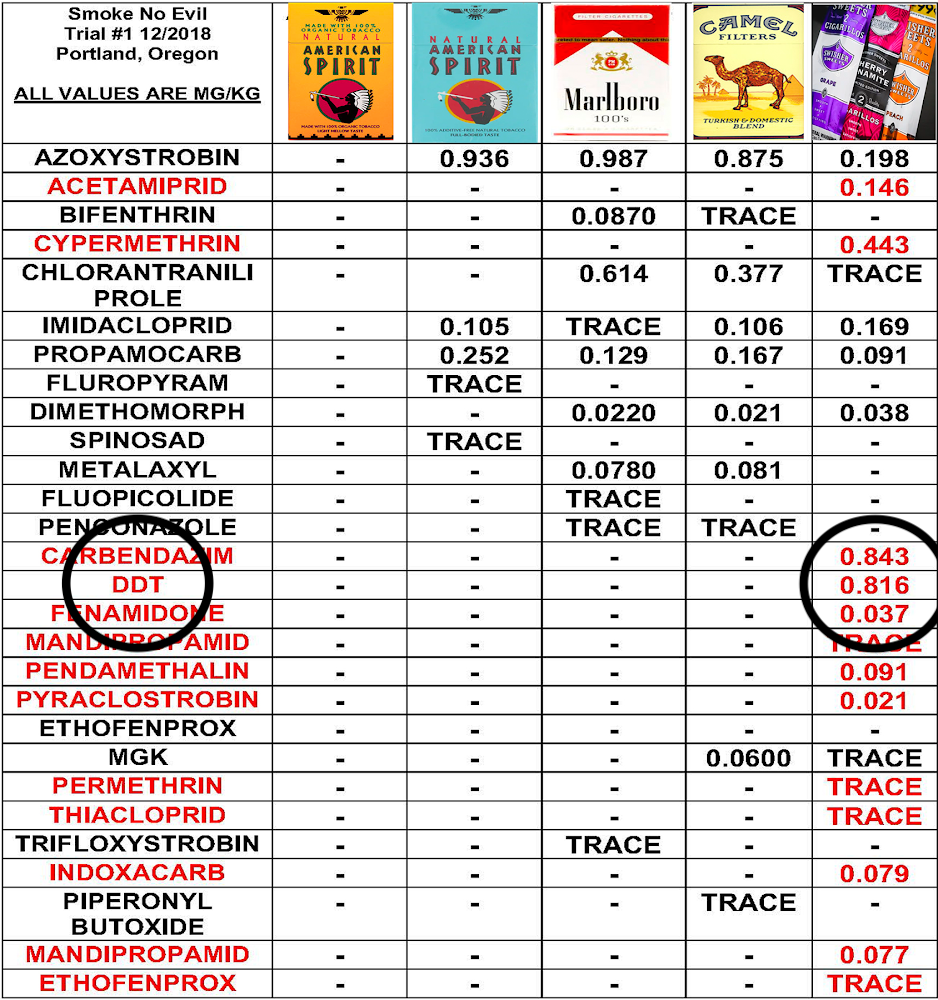
It’s reasonable to think that DDT exposure isn’t something to be concerned about in the US or Europe in 2025. Reasonable, but wrong. In my research testing five brands of tobacco products for pesticide contamination (see the data below), one brand of little cigar, Swisher Sweets, tested for 0.816 mg/kg DDT. This DDT concentration in little cigar smoke being inhaled by young people in their reproductive years is far greater than the environmental exposures that produced the generational effects revealed in this research, and this DDT is being inhaled multiple times a day by young Swisher Sweets smokers, many of whom are or will be pregnant. And while it seems obvious that at least some of the other pesticides that pregnant smokers inhale every day must have similar impacts on their children’s education, employment, and future relationships because their known modes of action are so similar.
From the Taiwan research:
“Our results show that on average exposure to one low-dose DDT spraying in early childhood was associated with a loss of about 0.04 years of schooling for both men and women, and the dose-response curves are nonlinear.”
“We found that the effect accumulated but the marginal effect of each additional spraying varied. In particular, the marginal effect of the first spraying tends to be larger than subsequent sprayings.”
“In terms of educational attainment, DDT mainly took effect at the margin of completing junior high school and senior high school.”
“We also found a negative effect on marriage.”
“As for employment, we did not find any significant effect on the probability of working. However both men and women with more DDT exposure as a child were more likely to work in the agricultural sector.”
“For men, more exposure also made them less likely to work in the manufacturing sector. Such findings are consistent with the findings on educational outcomes, because agricultural jobs often require less cognitive abilities and schooling.”
Here’s a look at data on pesticide residues found and quantified in selected US brands:
Finally, please consider this:
Pesticides and human chronic diseases: evidences, mechanisms, and perspectives
https://pubmed.ncbi.nlm.nih.gov/23402800/
There is a huge body of evidence on the relation between exposure to pesticides and elevated rate of chronic diseases such as different types of cancers, diabetes, neurodegenerative disorders like Parkinson’s, Alzheimer’s, and amyotrophic lateral sclerosis (ALS), birth defects, and reproductive disorders. There is also circumstantial evidence on the association of exposure to pesticides with some other chronic diseases like respiratory problems, particularly asthma and chronic obstructive pulmonary disease (COPD), cardiovascular disease such as atherosclerosis and coronary artery disease, chronic nephropathies, autoimmune diseases like systemic lupus erythematous and rheumatoid arthritis, chronic fatigue syndrome, and aging.“
“The common feature of chronic disorders is a disturbance in cellular homeostasis, which can be induced via pesticides’ primary action like perturbation of ion channels, enzymes, receptors, etc., or can as well be mediated via pathways other than the main mechanism.”
“In this review, we present the highlighted evidence on the association of pesticide’s exposure with the incidence of chronic diseases and introduce genetic damages, epigenetic modifications, endocrine disruption, mitochondrial dysfunction, oxidative stress, endoplasmic reticulum stress and unfolded protein response (UPR), impairment of ubiquitin proteasome system, and defective autophagy as the effective mechanisms of action.”
Not what any of us would want for our children, or any of the children of the world. Exposure through smoking contaminated tobacco and cannabis is purely an economic and political decision that a certain number of smokers must die so that the elites and the cartels can thrive. Once this is seen and understood more clearly, there’s at least the possibility of accountability and reform.


 panaceachronicles