Black smokers are nearly twice as likely to die of stroke and much more likely to die of heart attack compared to White smokers, and Black smokers also top the list for most other smoking-related causes of death. Virtually all Black smokers (88%) smoke Menthol cigarettes, while only a small proportion of White smokers do so. Although interestingly, White Menthol smokers’ chronic disease numbers are also higher than those of White non-Menthol smokers.
Taken together with new factual data (see below), the evidence strongly suggests that the difference in the disease and death rates between Black and White smokers may lie in Menthol’s ability to enhance penetration of cigarette smoke pesticides and fungicides at much greater rates into the organs, muscles and nerves of Black smokers.
The FDA has portrayed itself for years as a dedicated opponent of Menthol cigarettes, working strenuously toward a complete ban. The rationale for the proposed ban has always been that Menthol makes smoking easier and smoother, which attracts more smokers. Other federal and state agencies and non-profit organizations have also spent vast amounts of money trying to “educate” the Black community out of an overwhelming preference for Menthol cigarettes. After spending millions on misdirected research and pointless public health campaigns, quite predictably none of these totally off-target efforts have yielded any tangible results.
This raises a critical question: is there a reason why the FDA, a leading scientific agency in Tobacco and smoking research, with supposedly full knowledge of basic human physiology, has avoided using the single most compelling scientific argument against Menthol in cigarette smoke – that it is “one of the most effective terpenes used to enhance the dermal penetration of pharmaceuticals”1. Terpenes like Menthol increase the permeability of membranes, allowing harmful chemicals to penetrate tissues more effectively.
This property is particularly relevant to the health of smokers when you consider that all cigarettes, as you can see in the data below, are heavily contaminated with pesticides and fungicides, highly toxic chemicals with properties virtually identical to many pharmaceuticals and with wide-ranging health consequences which impact Black smokers at higher rates than White smokers. Here are some of the major areas that we know are impacted by chronic pesticide exposure, along with a look at some of the pesticides that all smokers are inhaling with every puff.
“Pesticides and human chronic diseases: evidences, mechanisms, and perspectives“
Chronic Diseases with Strong Causal Evidence:
- Many types of cancers
- Type 2 Diabetes
- Neurodegenerative disorders including Parkinson’s, Alzheimer’s, and ALS
- Birth defects
- Reproductive disorders
Chronic Diseases with Circumstantial Causal Evidence:
- Aging-related health issues
- Respiratory problems including asthma and COPD
- Cardiovascular diseases including atherosclerosis, coronary artery disease
- Chronic kidney diseases
- Autoimmune diseases including lupus, rheumatoid arthritis
- Chronic fatigue syndrome
Some of the Pesticides & Fungicides inhaled by smokers

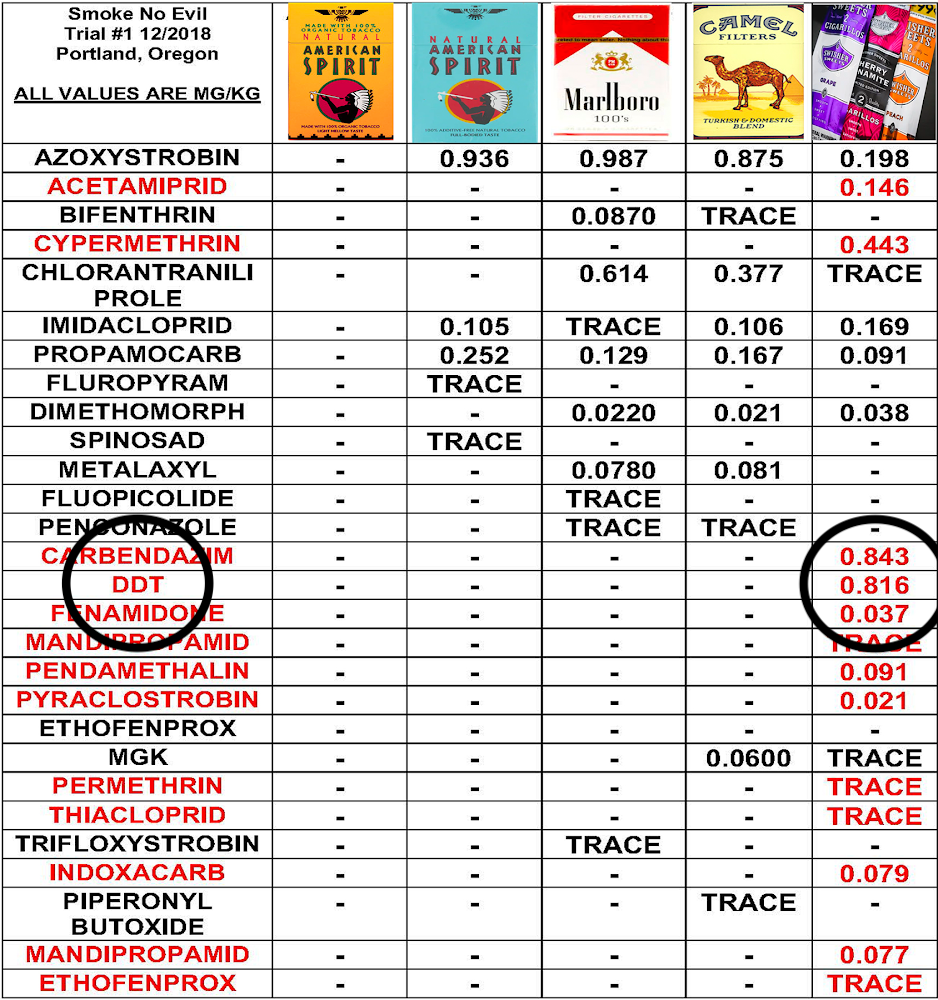
Menthol in cigarettes amplifies the absorption of these toxic pesticides and fungicides in cigarette smoke into the lungs, nerve tissues, and endocrine systems of smokers. The FDA’s refusal to acknowledge or regulate pesticide contaminants in cigarettes conveniently prevents it from addressing this amplification of toxicity, which has demonstrably deadly consequences for Menthol cigarette smokers.
The racial consequences of this enhanced pesticide chemical absorption are clear and devastating. Chronic exposure to inhaled cigarette smoke pesticides, with absorption facilitated by Menthol, appears to be leading to significantly higher rates of disease and mortality among Black Menthol cigarette smokers.
A recent study found that Menthol cigarette smoking, compared to non-menthol cigarette smoking, is associated with a 12% higher risk of all-cause mortality, a 16% increase in cardiovascular disease mortality, and a staggering 88% elevated risk of mortality from other heart diseases such as stroke among Black smokers2.
Since there have been precisely zero studies of the impact of increased absorption of inhaled pesticides in Menthol cigarettes, we can’t say for sure that increased pesticide absorption is responsible for all this increased cardiovascular risk among Black smokers, but that possibility can’t be eliminated either.

The impact of Menthol cigarette use on the Black community’s health and well-being is real and dramatic. Approximately 81% of Black smokers use Menthol cigarettes, compared to just 34% of white smokers3.
So that means that virtually every smoker in the Black community has hugely increased risk of heart disease directly because FDA allows cigarette manufacturers to conceal the pesticide contaminants in their products. This stark disparity, combined with the FDA’s inaction under the direction of the so-called “Tobacco” lobby, raises questions about knowledge, intent and accountability that may never be resolved. Unless, of course, enough people begin asking questions and demanding answers.
REFERENCES
1. “Menthol: a simple monoterpene with remarkable biological properties”
https://pubmed.ncbi.nlm.nih.gov/24054028/
2. “Association of menthol-flavored cigarette smoking with all-cause and cause-specific mortality risk”
https://tobaccocontrol.bmj.com/content/early/2025/02/12/tc-2024-059020
3. “Menthol Cigarette Use Among Adults Who Smoke Cigarettes, 2008-2020: Rapid Growth and Widening Inequities in the United States”
https://pubmed.ncbi.nlm.nih.gov/36223889/
4. “Pesticides and human chronic diseases: evidences, mechanisms, and perspectives“
https://pubmed.ncbi.nlm.nih.gov/23402800/


 panaceachronicles